用于日后检索和归档,建立知识索引。
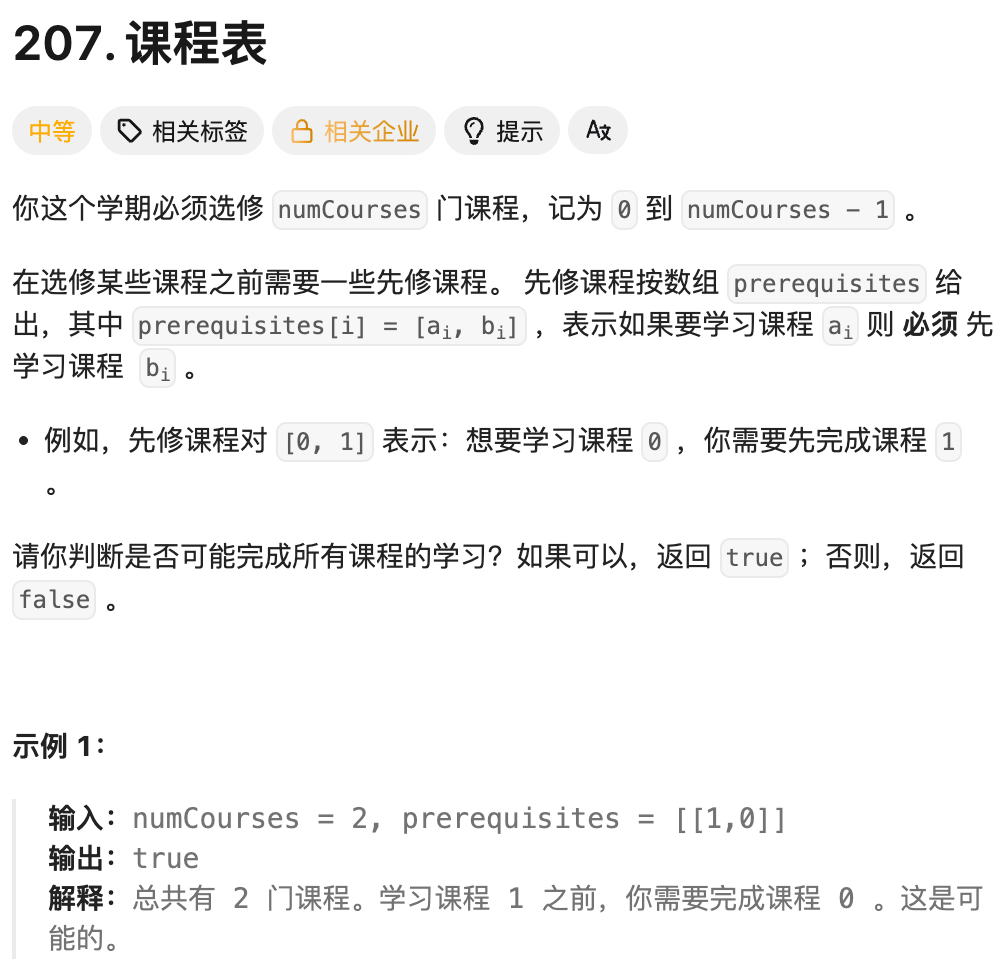
实验编号/标题:例如:实验-leetcode207-课程表
日期:2026-02-26
所属领域/标签:例如:#LeetCode #拓扑排序
耗时:2小时
🎯 实验前:假设与目标 (Plan)#
不要在此处长篇大论,用一两句话厘清“为什么做这个”。
当前问题 (Problem):#
核心假设 (Hypothesis):#
这是一个有向图判环问题。
- 找到所有入度为 0 的课程,加入队列。
- 从队列中取出一门课
- 后续课程的入度 - 1
- 某门后续课程入度变为 0 ,加入队列
- 查看是否所有课程入度都为 0
🧪 实验中:执行步骤与变量 (Do)#
执行步骤 (Log):#
Step1 建图,统计入度(临接表法)#
 1
 2
 3
 4
 5
 6
 7
 8
 9
10
11
12
13
14
15
16
| class Solution {
public boolean canFinish(int numCourses, int[][] prerequisites) {
List<List<Integer>> graph = new ArrayList<>();
for (int i = 0; i < numCourses; i ++) {
graph.add(new ArrayList<>());
}
int[] indegree = new int[numCourses];
for (int[] p: prerequisites) {
int a = p[0];
int b = p[1];
graph.get(b).add(a);
indegree[a]++;
}
}
}
|
Step2 入度为 0 的点入队#
 1
 2
 3
 4
 5
 6
 7
 8
 9
10
11
12
13
14
15
16
17
18
19
20
21
22
23
| class Solution {
public boolean canFinish(int numCourses, int[][] prerequisites) {
List<List<Integer>> graph = new ArrayList<>();
for (int i = 0; i < numCourses; i ++) {
graph.add(new ArrayList<>());
}
int[] indegree = new int[numCourses];
for (int[] p: prerequisites) {
int a = p[0];
int b = p[1];
graph.get(b).add(a);
indegree[a]++;
}
Deque<Integer> queue = new ArrayDeque<>();
for (int i = 0; i < numCourses; i ++) {
if (indegree[i] == 0) {
queue.offer(i);
}
}
}
}
|
Step3 入度为 0 的节点出队,相连节点入度 - 1#
 1
 2
 3
 4
 5
 6
 7
 8
 9
10
11
12
13
14
15
16
17
18
19
20
21
22
23
24
25
26
27
28
29
30
31
32
33
| class Solution {
public boolean canFinish(int numCourses, int[][] prerequisites) {
List<List<Integer>> graph = new ArrayList<>();
for (int i = 0; i < numCourses; i ++) {
graph.add(new ArrayList<>());
}
int[] indegree = new int[numCourses];
for (int[] p: prerequisites) {
int a = p[0];
int b = p[1];
graph.get(b).add(a);
indegree[a]++;
}
Deque<Integer> queue = new ArrayDeque<>();
for (int i = 0; i < numCourses; i ++) {
if (indegree[i] == 0) {
queue.offer(i);
}
}
int count = 0;
while (!queue.isEmpty()) {
int cur = queue.poll();
count ++;
for (int next : graph.get(cur)) {
indegree[next] --;
}
}
}
}
|
Step 4 入度为 0 的入队#
 1
 2
 3
 4
 5
 6
 7
 8
 9
10
11
12
13
14
15
16
17
18
19
20
21
22
23
24
25
26
27
28
29
30
31
32
33
34
35
36
37
| class Solution {
public boolean canFinish(int numCourses, int[][] prerequisites) {
List<List<Integer>> graph = new ArrayList<>();
for (int i = 0; i < numCourses; i ++) {
graph.add(new ArrayList<>());
}
int[] indegree = new int[numCourses];
for (int[] p: prerequisites) {
int a = p[0];
int b = p[1];
graph.get(b).add(a);
indegree[a]++;
}
Deque<Integer> queue = new ArrayDeque<>();
for (int i = 0; i < numCourses; i ++) {
if (indegree[i] == 0) {
queue.offer(i);
}
}
int count = 0;
while (!queue.isEmpty()) {
int cur = queue.poll();
count ++;
for (int next : graph.get(cur)) {
indegree[next] --;
if (indegree[next] == 0) {
queue.offer(next);
}
}
}
return count == numCourses;
}
}
|
👁️ 实验后:现象与数据 (Check)#
客观记录发生了什么,不要带主观评价。
观察到的现象:
成功了吗?报错了吗?报错信息是什么?
产出物的样子(附截图/照片)。
关键数据:
耗时、准确率、转化率、温度、分数等。
例:前5页成功,第6页开始报错 403 Forbidden。
🧠 深度复盘:分析与结论 (Act)#
这是学习发生的地方。将“经历”转化为“经验”。
结果对比:实际结果 vs. 预期假设。
符合预期 / 部分符合 / 完全相反
原因分析 (Why?):
为什么成功了?是运气还是方法对路?
为什么失败了?是假设错了,还是执行出问题了?
(可以使用“5个为什么”法进行深挖)
获得的知识点 (Key Learnings):
我学到了什么新概念?
纠正了什么旧认知?
下一步行动 (Next Actions):#
✅ 验证通过,纳入标准流程。
🔄 验证失败,修改假设,开启下一次实验(EXP-002)。
❓ 产生新问题:[记录新问题]