用于日后检索和归档,建立知识索引。
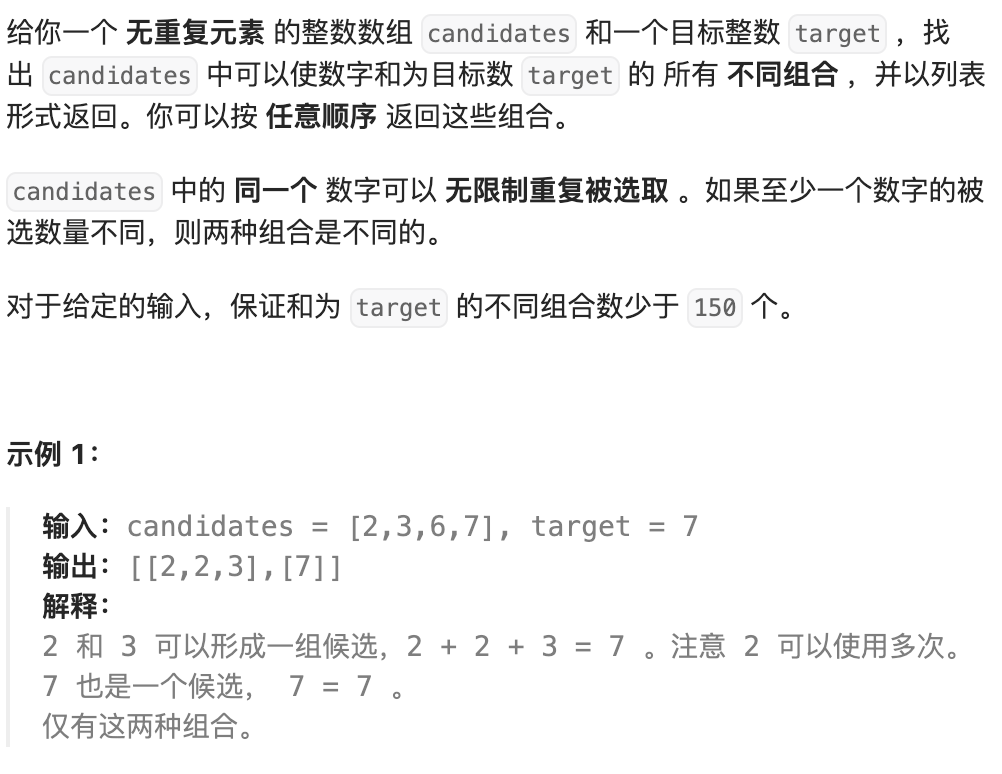
实验编号/标题:例如:实验-leetcode39-组合总数
日期: 2026-02-06
所属领域/标签:例如:#leetcode
耗时:2小时
🎯 实验前:假设与目标 (Plan)#
核心:测评当前位置开始,后面的数字里,那些可以继续选进来。
用 startIdx 控制下一层从哪里开始选。
- 当前层从 i 开始选一个数
- 下一层仍然从 i 开始继续选
- 不能回头选之前的数
当前问题 (Problem):我现在遇到了什么阻碍?或者我想解决什么问题?#
核心假设 (Hypothesis):(最关键的一步) 我认为怎么做能成功?#
🧪 实验中:执行步骤与变量 (Do)#
执行步骤 (Log):#
Step 1 定义路径和结果#
1
2
3
4
5
6
7
8
| class Solution {
List<List<Integer>> ans = new ArrayList<>();
List<Integer> path = new ArrayList<>();
public List<List<Integer>> combinationSum(int[] candidates, int target) {
}
}
|
Step 2 枚举每个数,做出选择#
 1
 2
 3
 4
 5
 6
 7
 8
 9
10
11
12
13
14
15
16
17
| class Solution {
List<List<Integer>> ans = new ArrayList<>();
List<Integer> path = new ArrayList<>();
public List<List<Integer>> combinationSum(int[] candidates, int target) {
dfs(candidates, 0, 0, target);
}
void dfs(int[] candidates, int startIdx, int sum, int target) {
for (int i = startIdx; i < candidates.length; i ++) {
path.add(candidates[i]);
dfs(candidates, i, sum + candidates[i], target);
path.remove(path.size() - 1);
}
}
}
|
Step 3 排序剪枝,当不可能凑到时,提前退出#
 1
 2
 3
 4
 5
 6
 7
 8
 9
10
11
12
13
14
15
16
17
18
19
20
21
| class Solution {
List<List<Integer>> ans = new ArrayList<>();
List<Integer> path = new ArrayList<>();
public List<List<Integer>> combinationSum(int[] candidates, int target) {
Arrays.sort(candidates);
dfs(candidates, 0, 0, target);
}
void dfs(int[] candidates, int startIdx, int sum, int target) {
for (int i = startIdx; i < candidates.length; i ++) {
if (candidates[i] + sum > target) {
break;
}
path.add(candidates[i]);
dfs(candidates, i, sum + candidates[i], target);
path.remove(path.size() - 1);
}
}
}
|
Step 4 符合条件加入集合#
 1
 2
 3
 4
 5
 6
 7
 8
 9
10
11
12
13
14
15
16
17
18
19
20
21
22
23
24
| class Solution {
List<List<Integer>> ans = new ArrayList<>();
List<Integer> path = new ArrayList<>();
public List<List<Integer>> combinationSum(int[] candidates, int target) {
Arrays.sort(candidates);
dfs(candidates, 0, 0, target);
return ans;
}
void dfs(int[] candidates, int startIdx, int sum, int target) {
if (sum == target) {
ans.add(new ArrayList<>(path));
return;
}
for (int i = startIdx; i < candidates.length; i ++) {
if (candidates[i] + sum > target) {
break;
}
path.add(candidates[i]);
dfs(candidates, i, sum + candidates[i], target);
path.remove(path.size() - 1);
}
}
}
|
👁️ 实验后:现象与数据 (Check)#
客观记录发生了什么,不要带主观评价。
观察到的现象:
成功了吗?报错了吗?报错信息是什么?
产出物的样子(附截图/照片)。
关键数据:
耗时、准确率、转化率、温度、分数等。
例:前5页成功,第6页开始报错 403 Forbidden。
🧠 深度复盘:分析与结论 (Act)#
这是学习发生的地方。将“经历”转化为“经验”。
结果对比:实际结果 vs. 预期假设。
符合预期 / 部分符合 / 完全相反
原因分析 (Why?):
为什么成功了?是运气还是方法对路?
为什么失败了?是假设错了,还是执行出问题了?
(可以使用“5个为什么”法进行深挖)
获得的知识点 (Key Learnings):
我学到了什么新概念?
纠正了什么旧认知?
下一步行动 (Next Actions):#
✅ 验证通过,纳入标准流程。
🔄 验证失败,修改假设,开启下一次实验(EXP-002)。
❓ 产生新问题:[记录新问题]