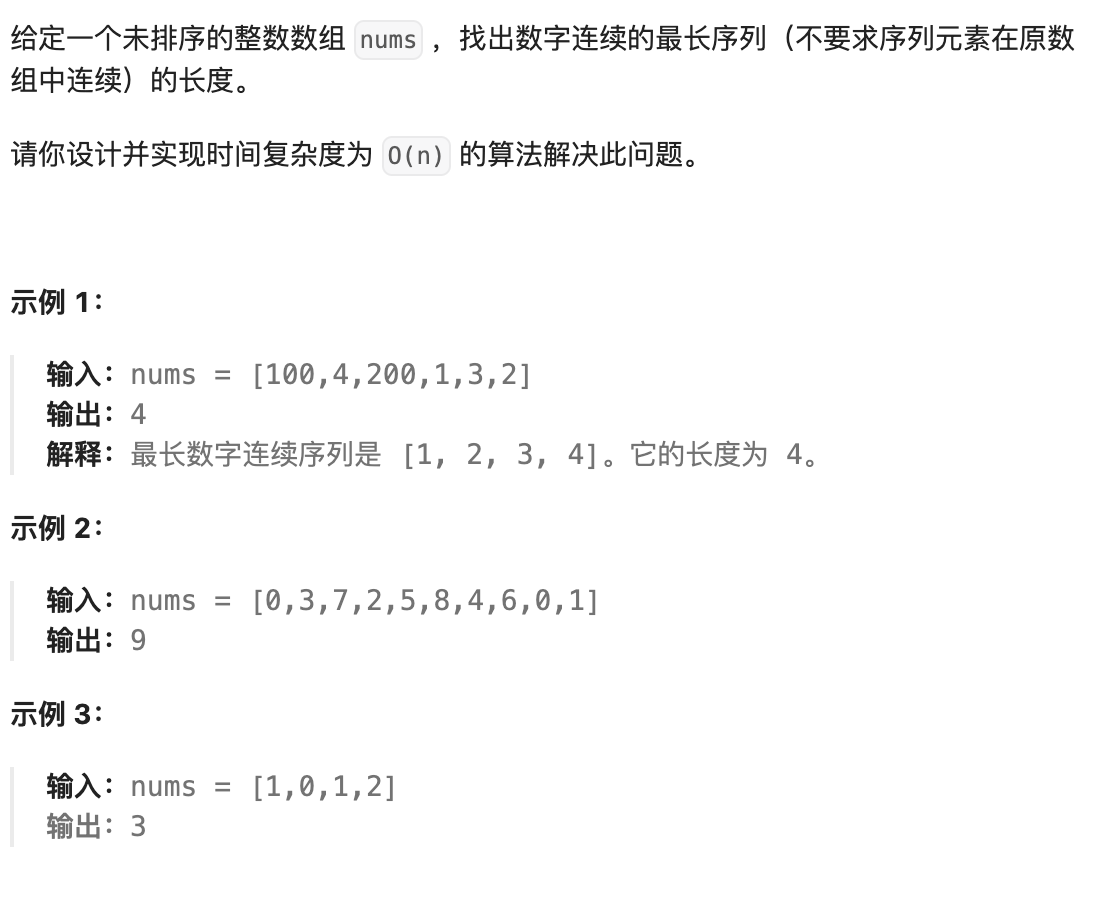
最长连续序列#
核心思路,假设这个序列由若干个子序列构成,每个子序列都是连续序列,目的就是找到这些子序列的长度最大值。
由于可能存在重复元素,所以需要对原始序列进行去重。
为了统计每个子序列的长度,我们可以取每个子序列的最小值,一直往上找它的下一个值是否在原序列中,如果存在,那么子序列长度 + 1。
最后对所有子序列的长度取一个最大值就是最终答案。
Java 解法#
 1
 2
 3
 4
 5
 6
 7
 8
 9
10
11
12
13
14
15
16
17
18
19
20
21
22
23
24
25
26
27
28
| class Solution {
public int longestConsecutive(int[] nums) {
if (nums.length == 0 ) {
return 0;
}
Set<Integer> set = new HashSet<>();
for (Integer num : nums) {
set.add(num);
}
int res = 1;
for (Integer num : set) {
if (set.contains(num-1)) {
continue;
}
int cur = 1;
int t = num + 1;
while(set.contains(t)) {
cur ++;
if (cur > res) {
res = cur;
}
t ++;
}
}
return res;
}
}
|
其实上面的代码可以简化一点, cur 可以用 y-x 提替代
 1
 2
 3
 4
 5
 6
 7
 8
 9
10
11
12
13
14
15
16
17
18
19
20
21
| import java.util.HashSet;
import java.util.Set;
class Solution {
public int longestConsecutive(int[] nums) {
Set<Integer> set = new HashSet<>(nums.length * 2);
for (int x : nums) set.add(x);
int ans = 0;
for (int x : set) {
// 只从“连续序列的起点”开始扩展,避免重复扫描,保证整体 O(n)
if (!set.contains(x - 1)) {
int y = x;
while (set.contains(y)) y++;
ans = Math.max(ans, y - x);
}
}
return ans;
}
}
|
python 解法#
 1
 2
 3
 4
 5
 6
 7
 8
 9
10
11
12
13
| class Solution:
def longestConsecutive(self, nums: List[int]) -> int:
s = set(nums)
ans = 0
for x in s:
if x - 1 not in s:
y = x
while y in s:
y += 1
ans = max(ans, y-x)
return ans
|
python set 用法:
 1
 2
 3
 4
 5
 6
 7
 8
 9
10
11
12
13
14
15
16
17
18
19
20
21
22
23
24
25
26
27
28
29
30
31
32
| # 初始化
s = set() # 空集合(注意:{} 是空 dict)
s = {1, 2, 3} # 字面量创建
s = set([1, 2, 2, 3]) # 去重 -> {1, 2, 3}
s = set("abca") # {'a','b','c'}
# 增加元素
s.add(10) # 加单个元素
s.update([1, 2, 3]) # 批量加入(可迭代对象)
# 删除元素
s.remove(10) # 不存在会抛 KeyError
s.discard(10) # 不存在不报错(更稳)
v = s.pop() # 随机弹出一个元素(集合无序)
s.clear() # 清空
# 查询元素
10 in s # 成员测试(平均 O(1))
len(s) # 元素个数
# 集合运算
# 并集
a | b
a.union(b)
# 交集
a & b
a.intersection(b)
# 查集
a - b
a.difference(b)
|
Go 解法#
 1
 2
 3
 4
 5
 6
 7
 8
 9
10
11
12
13
14
15
16
17
18
19
20
21
22
23
24
25
| func longestConsecutive(nums []int) int {
set := make(map[int]struct{}, len(nums))
for _, x := range nums {
set[x] = struct{}{}
}
ans := 0
for x := range set {
// 只从“序列起点”开始扩展,保证整体 O(n)
if _, ok := set[x-1]; ok {
continue
}
y := x
for {
if _, ok := set[y]; !ok {
break
}
y++
}
if y-x > ans {
ans = y - x
}
}
return ans
}
|
go 语言中,需要注意的就是没有 set 这一个数据结构,只有 map。
JS 解法#
 1
 2
 3
 4
 5
 6
 7
 8
 9
10
11
12
13
14
15
16
17
18
19
20
21
22
23
| /**
* LeetCode 128 - Longest Consecutive Sequence
* 时间复杂度:O(n) 平均
* 空间复杂度:O(n)
*
* @param {number[]} nums
* @return {number}
*/
function longestConsecutive(nums) {
const set = new Set(nums);
let ans = 0;
for (const x of set) {
// 只从“连续序列的起点”开始扩展,避免重复扫描
if (set.has(x - 1)) continue;
let y = x;
while (set.has(y)) y++;
ans = Math.max(ans, y - x);
}
return ans;
}
|